Drainage solutions for West TN & Kentucky.

Standing water, wet basements, and eroding yards — solved permanently, not patched. French drains, buried downspouts, channel drains, and yard grading from a crew that diagnoses the actual problem first.

The Problem With Standing Water

It's rarely just one wet spot.

Water that doesn't drain properly doesn't stay put — it moves along your foundation, breaks down soil under patios and driveways, kills grass, and creates the kind of standing puddles that take two days to dry out after every rain. Three other companies couldn't solve it for one Union City homeowner before we traced the actual grading issue and installed a French drain system that's held up through every storm since.

Water pools for 24–48 hours after rain

Wet basement or crawlspace after storms

Eroding mulch beds or bare patches in the yard

Mosquitoes breeding near the house

New cracks appearing in foundation or slab

Downspouts dumping water right next to the foundation

What We Install

Four ways to move water where it belongs.

Most yards need one of these, not all four — we diagnose before we quote.

French Drains

A buried perforated pipe surrounded by gravel that intercepts groundwater before it reaches your foundation or low spots, then channels it to a safe discharge point.

The most common fix for wet basements, soggy yards, and water tracking along a foundation line.

Best for: chronic wet spots, foundation seepage, sloped yards

Buried Downspouts

Your gutters may be working fine — the problem is often where they dump. We run solid pipe underground from the downspout to a discharge point well away from the house.

A simple fix that eliminates the erosion trench that forms under exposed downspout extensions.

Best for: foundation splashback, muddy trenches by the house

Channel Drains

A surface-level trench drain with a metal or plastic grate, installed across driveways, patios, or walkways to catch sheet-flowing water before it reaches a doorway or low point.

Where a French drain solves groundwater, a channel drain solves surface water in motion.

Best for: driveway aprons, patio edges, garage entries

Yard Grading

Sometimes the fix isn't a pipe at all — it's correcting the slope of the yard itself so water moves away from the house by gravity, the way it should have from the start.

Often paired with French drains or channel drains for a complete, permanent solution.

Best for: flat yards, low spots near the foundation, new construction
How We Approach It

Diagnose first, install second.

01

Site Evaluation

We trace where water actually comes from and where it goes — not just where it pools.

02

Right-Sized Design

French drain, channel drain, grading, or a combination — sized to your yard's actual water volume.

03

Clean Installation

Proper depth, slope, and gravel bedding so the system works for decades, not seasons.

04

Storm-Tested Follow-Up

We check back after the next real rain to confirm the fix is holding.

Recent Drainage Work

Real yards, real fixes.
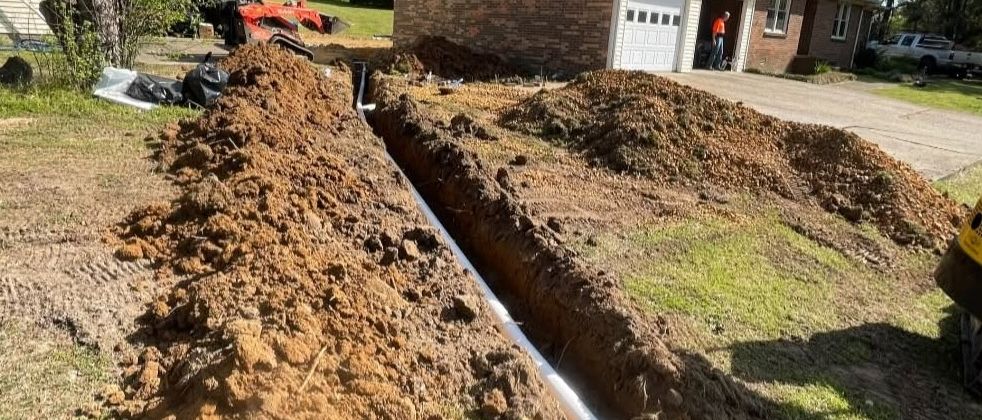
French drain trench and pipe installed alongside a residential driveway
French Drain System — Union City, TN
★★★★★

"We had serious drainage issues three other companies couldn't solve. They diagnosed it immediately and installed a French drain system that has worked perfectly through every storm since."

Sarah K. — Union City, TN
Common Questions

Drainage FAQ.

How much does a French drain cost?

Most residential French drain installations start around our $1,500 project minimum and scale with linear footage, depth, and discharge distance. Exact pricing depends on access, soil conditions, and yard size — which is why we start with a free on-site evaluation rather than a phone estimate.

How long does installation take?

Most single-system drainage projects (one French drain run or a set of buried downspouts) are completed in 1–3 days. Larger combined projects — grading plus multiple drain runs — can take longer. We'll give you a specific timeline after the site evaluation.

Do I need a permit for a French drain?

Most residential drainage work doesn't require a permit in our service area, but discharge location matters — we won't route water onto a neighbor's property or into a storm system that doesn't allow it. We handle these checks as part of the design.

Will this fix my wet basement?

Often, yes — most wet basements are caused by surface or groundwater intrusion that a properly designed French drain intercepts before it reaches the foundation. If the cause is a foundation crack or a plumbing issue instead, we'll tell you that directly rather than sell you drainage work that won't fix it.

What's the difference between a French drain and a sump pump?

A French drain moves water away from a problem area using gravity — no power, no moving parts, minimal maintenance. A sump pump collects water that's already gotten in and pumps it out. We generally recommend solving the problem before it enters (French drain) rather than managing it after (sump pump) wherever the yard's slope allows it.

Stop guessing. Get a real diagnosis.

Free on-site evaluation — we'll tell you exactly what's causing it and what it takes to fix it for good.

Request Free Estimate
📞 Call Now Free Estimate